
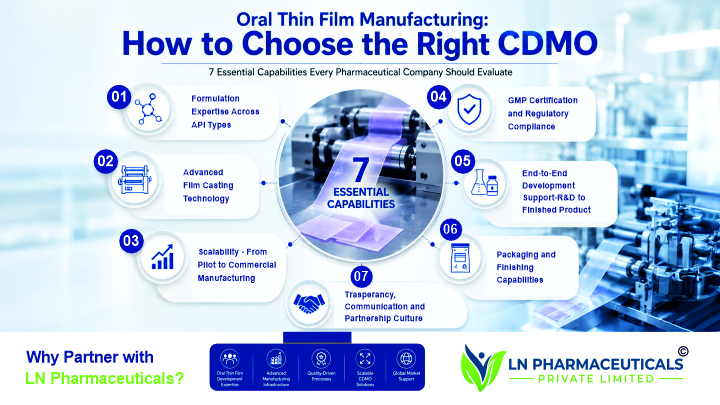
Oral Thin Film Manufacturing: How to Choose the Right CDMO
The global oral thin film market is valued at USD 3.61 billion in 2026 and growing at a CAGR of 9.35% through 2031 — making oral dissolving strips (ODS) one of the fastest-growing segments in pharmaceutical drug delivery today.
For pharma and nutraceutical brands looking to launch an oral thin film products the most critical decision you will make is not the formulation itself — it is choosing the right oral thin film CDMO (Contract Development and Manufacturing Organization) to bring it to life.
The wrong manufacturing partner can cost you months of delays, failed batches, and regulatory rejections. The right one accelerates your product to market, reduces your development risk, and gives your brand a competitive edge in a market growing at nearly 10% per year.
Oral thin film manufacturing CDMO guide covers the 7 essential capabilities every pharma and nutraceutical brand must evaluate before signing with an oral thin film manufacturer.
Table of Contents
Why Oral Thin Films Are the Dosage Form of the Decade?
Before evaluating CDMOs, it helps to understand why the demand for oral thin film manufacturing is accelerating so dramatically right now.
- The oral thin films market is projected to reach USD 7.18 billion by 2033 growing at 9.8% CAGR
- Over 65% of pediatric and geriatric patients prefer oral thin films over tablets due to ease of administration
- Oral thin films show dissolution times below 30 seconds in 72% of products
- Sublingual films account for 54.72% of market share — the dominant format in pharma OTF
- Asia Pacific is the fastest-growing region at 10.12% CAGR through 2031, driven by contract manufacturing clusters in India
The shift is being driven by three powerful forces operating simultaneously:
Patient compliance demand: An oral dissolving strip requires no water, no swallowing, and no measuring. For elderly patients, pediatric patients, and anyone with dysphagia — this is transformational. Patients who cannot or will not take tablets reliably will take a strip that dissolves in seconds.
Bioavailability advantage: Oral thin films can deliver active ingredients through the sublingual and buccal mucosa, bypassing first-pass metabolism entirely. This means faster therapeutic onset, more predictable plasma concentrations, and often lower required doses compared to conventional tablets.
Brand differentiation and lifecycle extension: For pharma companies with established molecules, reformulating into an oral thin film format extends product lifecycle, creates new IP, and opens new market segments — all at significantly lower cost than developing a new chemical entity.
The result is a rapidly growing pipeline of OTF products across pharma, nutraceuticals, and the emerging beverage supplement market — and a growing need for capable, reliable oral thin film CDMOs to manufacture them.
7 Essential Capabilities to Evaluate in an Oral Thin Film CDMO?
Not all oral thin film manufacturers are equal. The complexity of film formulation, casting technology, and regulatory compliance means that capability gaps between CDMOs can be significant — and the consequences of choosing the wrong partner are expensive.
Here are the seven capabilities that separate a world-class oral thin film CDMO from an average one.
Formulation Expertise Across API Types
The capability: A strong oral thin film CDMO must have deep formulation expertise across a wide range of active pharmaceutical ingredients (APIs) — not just experience with one or two molecules.
What to look for:
- Experience with hydrophilic APIs, poorly soluble APIs, and heat-sensitive compounds
- Proven taste-masking capabilities — critical for patient acceptance, especially in nutraceutical and paediatric OTF
- Ability to optimize release profiles: immediate release, sustained release, and buccal delivery
- In-house polymer science expertise — the polymer matrix is the foundation of every oral thin film
Why it matters for your product: If your API is poorly water-soluble or has a strong bitter taste, a CDMO without the right formulation expertise will struggle to produce an acceptable product — regardless of how advanced their equipment is. Formulation science is where most OTF projects succeed or fail.
Advanced Film Casting Technology
The capability: The two primary manufacturing technologies for oral thin films are solvent casting and hot-melt extrusion (HME). A capable CDMO should offer both — or at minimum be highly proficient in the one suited to your product.
What to look for:
- Solvent casting: The most widely used method — the polymer-API solution is cast onto a surface, dried uniformly, and cut to size. Produces consistent, thin films with excellent uniformity.
- Hot-melt extrusion (HME): Solvent-free process — better for heat-stable APIs and products requiring sustained release profiles. Approximately 65% of CDMOs are now investing in solvent casting alternatives like HME.
- Inline quality control during casting — weight uniformity, thickness consistency, dissolution testing
- Modern, continuous casting lines capable of both small pilot batches and large commercial volumes
Why it matters: The casting technology directly determines your film’s dissolution time, uniformity, and stability profile. A CDMO with only one casting technology will try to make your product fit their process — rather than selecting the right process for your product.
Scalability — From Pilot to Commercial Manufacturing
The capability: Many CDMOs can produce small R&D batches. Far fewer can seamlessly scale from a 10,000-strip pilot run to a 10-million-strip commercial production run without quality loss or timeline delays.
What to look for:
- Dedicated pilot-scale equipment that mirrors commercial-scale processes
- Documented scale-up protocols and experience scaling OTF products through clinical phases
- Capacity planning transparency — can they accommodate your commercial volume within your target launch timeline?
- Flexibility for both small batch nutraceutical OTF runs and large pharma commercial volumes
Why it matters: The gap between pilot and commercial manufacturing is where most OTF projects experience their biggest delays. A CDMO that has not successfully scaled an OTF product to commercial volumes will be learning on your timeline and your budget.
Looking for innovative oral dissolving strip manufacturing? Visit Oral Thin Film Manufacturer |
GMP Certification and Regulatory Compliance
The capability: For pharmaceutical oral thin film products, GMP (Good Manufacturing Practice) compliance is not optional — it is the minimum requirement. But the level and scope of GMP certification matters significantly depending on where you plan to sell your product.
What to look for:
- WHO-GMP certification — essential for export to regulated markets worldwide
- ISO certification — quality management system compliance
- Experience with regulatory submissions in your target markets (India CDSCO, US FDA, EU EMA, UK MHRA)
- Clean room facilities appropriate for OTF manufacturing
- Comprehensive batch documentation and quality control testing — dissolution, uniformity, stability, microbial
Why it matters: If you plan to export your oral thin film product internationally, your CDMO’s regulatory certifications directly determine which markets you can access. A manufacturer with only domestic GMP certification cannot support your global ambitions.
End-to-End Development Support — R&D to Finished Product
The capability: The best oral thin film CDMOs do not just manufacture — they partner. This means providing genuine R&D support from early formulation concept through stability studies, clinical batch manufacturing, and commercial production.
What to look for:
- In-house R&D team with OTF-specific expertise
- Pre-formulation services — API characterisation, excipient compatibility studies, polymer selection
- Stability testing capabilities (accelerated and real-time) to support regulatory dossier preparation
- Technology transfer support if you are moving from another CDMO or from lab scale
- Dedicated project management — a single point of contact who manages your product from formulation to dispatch
Why it matters: If your CDMO only provides manufacturing services and you need to source R&D support separately, you create coordination gaps, longer timelines, and quality risks between development and production. End-to-end capability under one roof is a significant competitive advantage.
Packaging and Finishing Capabilities
The capability: An oral dissolving strip’s final packaging is as critical to its quality and shelf life as the film formulation itself. Moisture, light, and temperature all degrade OTF products — making packaging capability a core manufacturing competency, not an afterthought.
What to look for:
- Individual sachet packaging — the standard for single-dose ODS products
- Aluminium foil packaging — provides the moisture and light barrier OTF products require
- Child-resistant and senior-friendly packaging options
- Custom carton and labelling capabilities for branded products
- White-label packaging for contract-manufactured products
Why it matters: Many brands discover too late that their CDMO cannot provide the packaging format their market requires — forcing them to outsource final packaging to a third party, adding cost, complexity, and quality risk.
Transparency, Communication, and Partnership Culture
This is the capability that no brochure will advertise — but it is often the one that determines whether a CDMO relationship succeeds or fails. Oral thin film manufacturing projects are complex, multi-month engagements. You need a partner who communicates clearly, manages challenges proactively, and treats your product as a priority.
What to look for:
- Clear and responsive communication during the evaluation process — slow, vague responses before you sign are a reliable predictor of behaviour after you sign
- Willingness to share facility tour access, reference contacts, and audit documentation
- Honest timelines — a CDMO who promises unrealistically fast turnarounds is often setting you up for disappointment
- Flexibility to accommodate your product requirements rather than forcing your product into their standard process
- Genuine interest in understanding your brand, your market, and your customer
Why it matters: Even the most technically capable CDMO is a poor partner if they are unresponsive, opaque about timelines, or treat your product as low priority. Cultural fit matters as much as technical fit in a long-term manufacturing relationship.
Why LN Pharmaceuticals Is the Right Oral Thin Film Manufacturing Partner?
LN Pharmaceuticals is a GMP-certified oral thin film manufacturer based in Hyderabad, India — delivering end-to-end OTF contract manufacturing for pharma and nutraceutical brands worldwide.
Our ThinFuel® Technology platform enables us to manufacture oral dissolving strips across a full range of therapeutic categories — from sublingual pharma films to nutraceutical vitamin strips and functional beverage OTF products.
What we offer:
- ✅ GMP-certified oral thin film manufacturing facility
- ✅ End-to-end capability — formulation R&D through finished goods packaging
- ✅ Advanced solvent casting technology for consistent, high-quality ODS products
- ✅ Complete documentation support — Certificate of Analysis (CoA), manufacturing licences, batch records, stability reports, and regulatory dossier assistance for every product we manufacture
- ✅ Pharma, nutraceutical, and beverage OTF expertise
- ✅ Export-ready manufacturing for international regulatory markets
- ✅ Small pilot batches to full commercial scale
- ✅ Dedicated project management — one team, one point of contact
Whether you are developing your first oral thin film product or looking to switch to a more capable manufacturing partner, our team is ready to discuss your requirements.
CONCLUSION
The oral thin film market is growing at nearly 10% annually — and brands that move quickly with the right manufacturing partner will capture a disproportionate share of that growth.
Use the 7 capabilities in this guide as your evaluation framework. And prioritise a partner who treats your product as a genuine collaboration — not just another manufacturing order.
The right oral thin film CDMO does not just manufacture your product. They become a core part of your competitive advantage.