
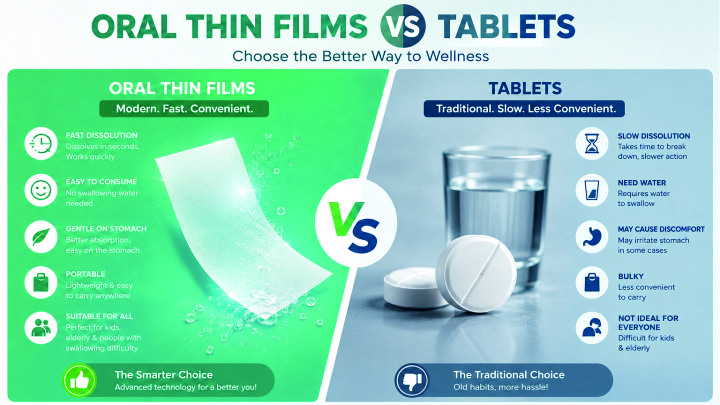
Oral Thin Films vs. Tablets: Which Is Better for Medication Adherence?
Oral Thin Films vs Tablets: Which Is Better for Medication Adherence?
Every medication is only as effective as the patient’s ability and willingness to take it — consistently, correctly, and at the right time.
Medication non-adherence is one of the most significant clinical and economic problems in global healthcare. An estimated 50% of patients with chronic conditions do not take their medication as prescribed, leading to disease progression, avoidable hospitalisations, and billions in preventable healthcare costs annually.
The dosage form plays a larger role in adherence than most people realize. A medication that is difficult to swallow, unpleasant in taste, or inconvenient to administer will not be taken reliably — regardless of how effective the active ingredient is.
This is precisely why the pharmaceutical industry is shifting its focus toward patient-centric drug delivery — and why oral thin films (OTFs), also known as oral dissolving strips (ODS), are one of the fastest-growing dosage forms in the world today.
But how exactly do oral thin film compare to conventional tablets? And for which patients does the OTF format deliver a genuinely superior therapeutic outcome?
Comparing oral thin film vs tablets—which is better? This article answers that question through a comprehensive, evidence-based comparison of bioavailability, dissolution, patient compliance, dosage accuracy, stability, and manufacturing considerations, enabling pharmaceutical professionals, brand owners, and healthcare providers to select the most appropriate dosage form for their products and patients.
What Are Oral Thin Films?
Oral thin films are ultra-thin, flexible strips — typically 1 to 20 cm² in area — containing an active pharmaceutical ingredient (API) embedded in a hydrophilic polymer matrix. When placed on the tongue or inside the cheek, the film absorbs saliva, begins to dissolve within seconds, and releases the active ingredient for rapid absorption through the oral mucosa.
The OTF format encompasses several delivery mechanisms:
Orodispersible films (ODFs): Placed on top of the tongue — rapid disintegration and dissolution for immediate release.
Sublingual films: Placed under the tongue — API absorbed directly through the sublingual mucosa into systemic circulation, bypassing first-pass hepatic metabolism.
Buccal films: Placed inside the cheek — sustained mucosal contact for controlled drug release.
Each format is suited to different APIs, therapeutic indications, and patient populations — providing a level of delivery flexibility that conventional tablets cannot match.
What Are Conventional Tablets?
Conventional tablets are compressed solid dosage forms containing an API combined with excipients — binders, fillers, disintegrants, lubricants, and coating materials. They are swallowed whole and dissolved in the gastrointestinal tract, where the API is absorbed into the bloodstream through the intestinal wall.
Tablets have been the dominant oral dosage form for over a century — and for good reason. They are cost-effective to manufacture, stable under a wide range of storage conditions, and suitable for a broad range of APIs and therapeutic indications.
However, tablets are designed around the assumption that the patient can swallow them reliably. For a significant and growing segment of the global patient population, this assumption does not hold.
Difference Between Oral Thin Films and Tablets
1. Bioavailability and Absorption
Tablets:
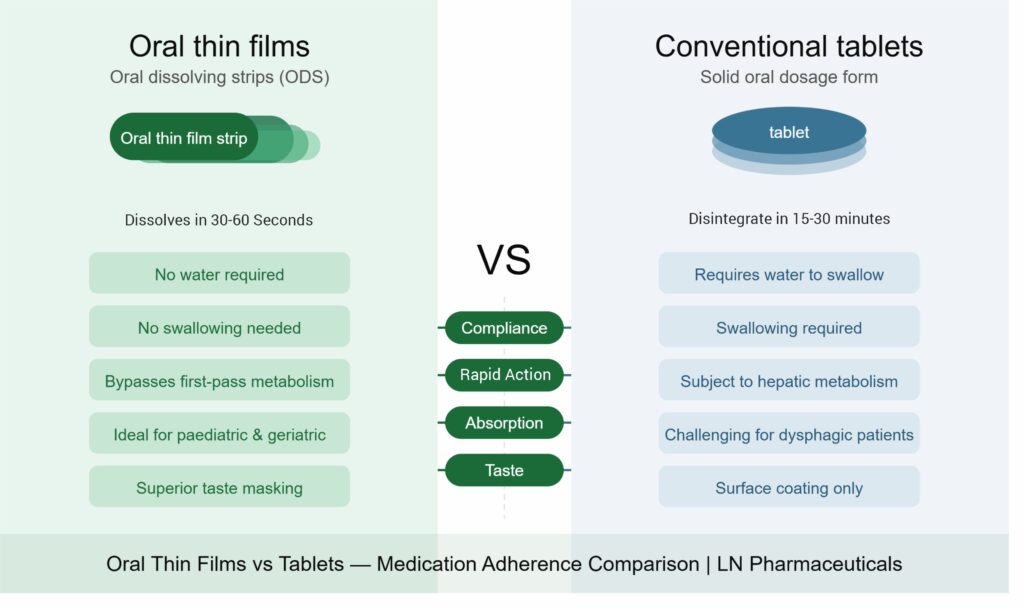
When a tablet is swallowed and travels through the gastrointestinal tract, the API undergoes first-pass hepatic metabolism before reaching systemic circulation. A proportion of the active ingredient is metabolised by the liver before it can exert its therapeutic effect — reducing effective bioavailability. The extent of first-pass metabolism varies significantly between APIs but can reduce systemic availability by 20–80% for some compounds.
Oral Thin Films:
Sublingual and buccal OTF delivery bypasses the gastrointestinal tract and first-pass hepatic metabolism entirely. The API is absorbed directly through the highly vascularised oral mucosa — entering systemic circulation more rapidly and at higher effective concentrations than the equivalent tablet dose. For APIs with significant first-pass metabolism, OTF reformulation can meaningfully improve therapeutic performance at the same or lower total dose.
Verdict: OTF wins — particularly for APIs with significant first-pass metabolism or where rapid therapeutic onset is clinically important.
2. Dissolution Time and Onset of Action
Tablets:
Conventional tablets must disintegrate in the stomach before the API can dissolve and be absorbed. Disintegration typically takes 15 to 30 minutes, followed by additional time for GI absorption. Total time to therapeutic effect for most oral tablets is 30 to 90 minutes.
Oral Thin Films:
OTFs dissolve on the tongue within 5 to 30 seconds. The API begins absorbing through the oral mucosa almost immediately — with measurable plasma concentrations achievable within minutes of administration. For acute conditions — nausea, migraine, anxiety, acute pain — this speed of onset is not merely convenient but clinically significant.
Verdict: OTF wins — dramatically faster onset of action, critical for acute therapeutic applications.
3. Patient Compliance and Ease of Administration
Tablets:
Dysphagia — difficulty swallowing — affects an estimated 15% of the general elderly population and up to 68% of nursing home residents. For these patients, swallowing a tablet is not merely uncomfortable — it is a genuine safety risk, associated with choking, aspiration pneumonia, and medication refusal.
Beyond geriatric patients, paediatric patients routinely refuse tablets, psychiatric patients may struggle with swallowing during episodes, and post-surgical patients may have restricted swallowing ability. For all these populations, tablets represent a compliance barrier that directly compromises therapeutic outcomes.
Oral Thin Films:
OTFs require no swallowing and no water. The strip is placed on the tongue and dissolves within seconds. This eliminates the compliance barrier for patients with dysphagia, removes medication refusal as a practical option for paediatric dosing, and enables self-administration in virtually any setting — including post-surgical recovery, travel, and emergency situations.
Verdict: OTF wins — decisive advantage for paediatric, geriatric, dysphagia, psychiatric, and acute care patient populations.
4. Taste and Palatability
Tablets:
Many APIs have bitter, metallic, or astringent tastes. Tablet coatings — sugar coating, film coating — provide some taste masking, but the coating must dissolve before absorption begins, and breakthrough bitterness is common, particularly in chewable or rapidly dissolving tablet formats. For children and elderly patients, taste is a primary driver of medication refusal.
Oral Thin Films:
OTF formulations incorporate taste masking directly into the polymer matrix through microencapsulation, cyclodextrin complexation, ion-exchange resin technology, and optimised flavouring and sweetener systems. Because taste masking is engineered at the molecular level rather than applied as a surface coating, it is significantly more effective and durable than tablet coating. Well-formulated OTFs can make even intensely bitter APIs palatable — a critical advantage for paediatric and nutraceutical applications.
Verdict: OTF wins — superior taste masking capability, particularly relevant for APIs with difficult taste profiles.
5. Dosage Accuracy and Content Uniformity
Tablets:
Tablet manufacturing can achieve good content uniformity, but inconsistencies in granulation, compression, and coating can introduce variation — particularly at low doses where small absolute variations represent large percentage errors. Splitting tablets to achieve lower doses introduces significant dosage inaccuracy.
Oral Thin Films:
Advanced OTF manufacturing using solvent casting technology — with inline near-infrared (NIR) spectroscopy monitoring during casting — achieves content uniformity within ±5% of the stated dose across every unit in a batch. Each strip is a precisely defined, individually packaged unit dose — no splitting, no estimation, no variation. For low-dose APIs and paediatric dosing where accuracy is critical, OTFs provide a manufacturing precision advantage over tablets.
Verdict: OTF wins for low-dose precision — tablets perform well at standard adult doses.
6. Stability and Shelf Life
Tablets:
Conventional coated tablets offer excellent stability under appropriate storage conditions. The compressed, coated tablet core provides good protection for the API against moisture, light, and oxygen — supporting shelf lives of 24 to 36 months for most formulations.
Oral Thin Films:
OTFs are hygroscopic — the hydrophilic polymer matrix that enables rapid dissolution also makes the film susceptible to moisture uptake. Without appropriate packaging — typically individual aluminium foil sachets with high moisture-barrier properties — OTF stability is compromised. Well-packaged oral thin film products achieve shelf lives of 18 to 24 months, slightly shorter than coated tablets for moisture-sensitive formulations.
Verdict: Tablets win marginally on stability — OTFs require careful packaging design but can achieve comparable shelf lives with appropriate moisture-barrier packaging.
Looking for innovative oral dissolving strip manufacturing? Visit Oral Thin Film Manufacturer |
7. Manufacturing Cost and Scalability
Tablets:
Tablet manufacturing is one of the most mature, high-volume pharmaceutical manufacturing processes. Capital equipment costs are moderate relative to throughout, and the manufacturing process is well-understood, widely validated, and supported by a large global equipment and excipient supply chain.
Oral Thin Films:
Commercial-scale OTF manufacturing requires specialist solvent casting equipment, controlled humidity environments, and trained process engineers. Capital investment for a commercial OTF line is significantly higher than equivalent tablet capacity. However, for brands partnering with an established OTF CDMO, this capital investment is amortised across multiple client programmes — making commercial-scale OTF manufacturing economically accessible without in-house capital expenditure.
Verdict: Tablets win on pure manufacturing cost — OTFs require specialist infrastructure but are accessible through CDMO partnerships.
When Are Oral Thin Films the Right Choice?
OTF is the superior dosage form choice in the following clinical and commercial contexts:
Paediatric medications:
Where tablet refusal and inaccurate crushing/splitting are the primary compliance barriers — OTF eliminates both.
Geriatric medications:
Where dysphagia or cognitive impairment makes reliable tablet administration unsafe or impractical.
Acute condition medications:
Anti-emetics (Ondansetron), migraine treatments, anxiolytics, sublingual cardiovascular medications — where rapid onset of action is therapeutically critical.
APIs with significant first-pass metabolism:
Where sublingual or buccal OTF delivery can improve effective bioavailability and potentially reduce the required dose.
Nutraceutical supplements:
Where consumer convenience and taste are primary purchase drivers — Vitamin B12, D3, Iron, Folate, Melatonin strips offer a more compelling consumer proposition than tablets.
Partner With LN Pharmaceuticals for Your Oral Thin Film Product
LN Pharmaceuticals is a GMP-certified oral thin film manufacturer and CDMO based in Hyderabad, India — offering end-to-end contract manufacturing of oral dissolving strips for pharma and nutraceutical brands worldwide.
Whether you are reformulating an existing molecule into OTF format, developing a new nutraceutical dissolving strip, or exploring OTF manufacturing for the first time — our formulation R&D and manufacturing team is ready to bring your product to commercial scale.
(1) Comment
read more
March 26, 2026Good day! I could have sworn I’ve been to your blog before but after browsing through a few of the articles I
realized it’s new to me. Anyways, I’m certainly delighted I came across it and I’ll be bookmarking
it and checking back often!