
Revolution in Drug Delivery: Oral Thin Film Technology
Revolution in Drug Delivery: Oral Thin Film Technology
The global oral thin film market is valued at USD 3.73 billion in 2026 and growing at 9.8% CAGR through 2033. Pain management accounts for 42% of market share. Psychiatric disorders contribute 30%. As of 2026, the drug-loaded oral thin films segment alone is projected to exceed USD 2.1 billion, with a 12.5% CAGR anticipated through 2033, driven by rising demand for needle-free therapies and advancements in biocompatible polymer technologies.
These numbers reflect a technology that has moved decisively from niche application to mainstream pharmaceutical platform — and the innovation driving this transition is accelerating, not plateauing.
Nanotechnology Integration — The Solubility Solution
The most significant technical barrier limiting OTF applications has historically been poor water solubility. An estimated 40% of approved drugs and 90% of drugs in development are classified as poorly water-soluble (BCS Class II and IV) — and incorporating these APIs uniformly into a hydrophilic polymer matrix presents formidable formulation challenges.
Nanotechnology is systematically dismantling this barrier. Nanoparticles and lipid-based carriers can be incorporated into the film matrix to enhance drug absorption through the oral mucosa, leading to increased efficacy and reduced dosage requirements. The specific nanotechnology platforms being integrated into OTF formulations include:
Nanosuspensions: Reducing API particle size to the nanometre range (typically 100–500 nm) dramatically increases the surface area available for dissolution — improving both drug loading capacity and dissolution rate from the film matrix. NSC-based nanosuspension systems currently attract approximately 35% of OTF-related R&D investment.
Niosome-embedded films: Research published in 2025 demonstrated that incorporating niosomes into HPMC oral thin film matrices significantly improved metoprolol tartrate bioavailability and extended drug release duration compared to conventional tablet formulations — validating the combination of vesicular nanocarrier delivery with OTF polymer matrices.
Nanocomposites: Drug-polymer composite nanoparticles that disperse uniformly in casting solutions, enabling high drug loading with excellent content uniformity — addressing one of the most persistent quality challenges in OTF manufacturing.
Emulsion-based platforms: IntelGenx Corp.’s proprietary emulsion-based OTF platform demonstrates how nanotechnology enables oral thin film delivery of APIs with poor oral bioavailability — by facilitating buccal or sublingual absorption that bypasses first-pass hepatic metabolism entirely.
Multilayered Film Architecture
A second major technology innovation is the development of multilayered laminated OTF structures — films containing multiple active pharmaceutical ingredients, functional separation layers, or different release profiles within a single strip.
Multilayered OTF architecture addresses several critical formulation challenges simultaneously:
API incompatibility: Incompatible APIs that cannot be combined in a single layer are separated by a functional barrier layer — maintaining chemical stability while delivering combination therapy in a single dosage form.
Dual release profiles: Different layers can be formulated for immediate and sustained release — providing the rapid onset of sublingual absorption combined with extended duration of action in one film.
Taste masking isolation: The taste-masked API layer and the flavour/sweetener layer are physically separated — optimising taste masking performance without compromising API release.
Combination drug films represent a particularly significant commercial opportunity. For patients with hypertension, diabetes, HIV, or psychiatric conditions who require multiple daily medications, a single multilayered OTF strip red
uces pill burden, simplifies administration, and directly improves adherence.
Roll-to-Roll Manufacturing — The Commercial Scale Revolution
Technological advancements are transforming the oral thin films market by enabling the development of more sophisticated formulations, enhanced drug stability, and improved manufacturing processes.
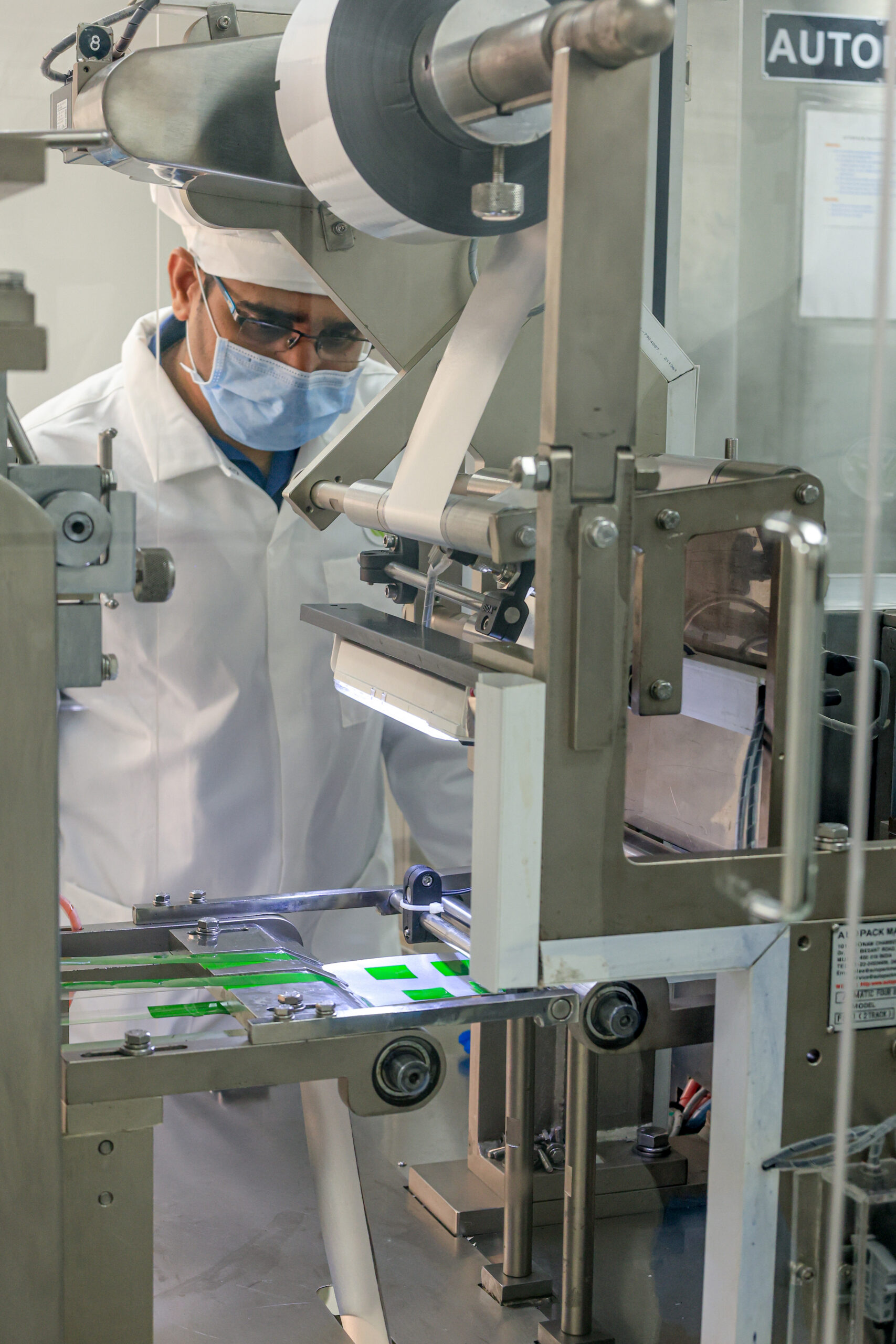
Roll-to-roll (R2R) continuous processing represents the most transformative manufacturing advancement in the OTF sector — integrating film casting, multi-zone drying, inline quality monitoring, slitting, and cutting into a single continuous manufacturing operation.
The commercial impact of R2R processing is substantial:
- Continuous production eliminates batch-to-batch variability — improving quality consistency across large commercial volumes.
- Precision coating controls wet film thickness to micron-level accuracy across the full web width throughout production.
- Inline NIR monitoring enables real-time content uniformity verification during casting — catching deviations before they become batch failures.
- Reduced waste — continuous processes generate significantly less process waste than discrete batch manufacturing.
- Cost reduction — high production costs have historically been one of the primary barriers to OTF adoption; R2R processing directly reduces the per-unit manufacturing cost that previously limited commercial scalability.
“Looking for innovative oral dissolving strip manufacturing? Visit Oral Thin Film Manufacturer |
Smart Film Technologies — The Emerging Frontier
Future developments focus on personalized OTFs, made possible by printing technologies like inkjet and 3D printing, offering tailored dosing and drug combinations.
The next frontier in oral thin film technology is the integration of intelligent systems within the film matrix itself:
Microsensor-embedded films: Smart thin films containing microsensors that monitor patient-specific biomarkers — pH levels, enzyme activity, glucose concentration — and modulate drug release in real time based on physiological data. For chronic disease management where precise dosing and timing are clinically critical, adaptive drug release represents a transformation in therapeutic personalisation.
pH-sensitive films: Films engineered to release drug in response to specific pH environments — releasing API in the buccal cavity at physiological pH but remaining stable at acidic gastric pH. This pH-responsive release mechanism enables targeted delivery to specific mucosal sites.
Market Dynamics — The Global OTF Technology Landscape
Regional Leadership
Pain management dominates at 42% of market share, driven by the growing preference for non-invasive, rapid-acting analgesics. Psychiatric disorders contribute 30%, fuelled by innovations in ADHD and anxiety treatments.
Asia-Pacific — Fastest Growing Market (10.12% CAGR through 2031):
Asia-Pacific is the fastest-growing OTF regional market, driven by improving healthcare infrastructure, growing pharmaceutical R&D investment, and the emergence of India as a significant OTF contract manufacturing hub. China’s market is growing 7.3% to USD 3.7 billion by 2030, reflecting better healthcare facilities, more R&D investment, and growing awareness of advanced drug delivery formats.
India’s position in the global OTF landscape is particularly significant. The combination of GMP-certified manufacturing capability, deep API supply chain access, competitive manufacturing cost structure, and growing regulatory expertise makes Indian OTF manufacturers increasingly attractive to international pharma and nutraceutical brands seeking cost-effective, export-ready contract manufacturing partnerships.
Therapeutic Expansion
The therapeutic reach of oral thin film technology is expanding rapidly beyond the neurological and psychiatric indications that established the platform. Current commercial and pipeline applications span:
Established therapeutic areas:
- Anti-emetics (ondansetron ODS) — Zuplenz established the precedent
- Erectile dysfunction (sildenafil, tadalafil sublingual films)
- Neurological emergency (apomorphine — KYNMOBI)
- Acute psychiatric care (dexmedetomidine — IGALMI)
- Chronic pain (buprenorphine buccal film)
- Emergency allergy (epinephrine — Anaphylm)
Expanding therapeutic areas:
- Nutraceuticals and vitamins — B12, D3, Iron, Folate, Melatonin ODS
- OTC allergy and pain management — supported by June 2025 FDA guidance
- Diabetes management — buccal insulin film research ongoing
- Vaccine delivery — OTF platforms for mucosal vaccine administration under investigation
- Probiotic delivery — pH-sensitive films for targeted gastrointestinal release
Regulatory Landscape — A Progressively Supportive Framework
FDA Pathway Advantages
The regulatory pathway for oral thin film products has become significantly clearer over the past five years — reducing development risk and shortening time to market for OTF reformulations of existing approved molecules.
505(b)(2) pathway: Allows new OTF formulations of existing approved drug molecules to leverage existing safety and efficacy data from the reference listed drug — reducing the clinical development burden for OTF reformulation programmes and shortening approval timelines. This pathway has been used successfully for multiple OTF approvals and represents the primary regulatory strategy for pharma brands pursuing OTF reformulation of established molecules.
June 2025 FDA guidance: The FDA issued final guidance specifically easing conversions from tablets to orally disintegrating films for certain OTC products — explicitly acknowledging OTF technology as a viable and clinically equivalent alternative to solid oral dosage forms for OTC applications. This guidance opens the entire OTC category to OTF reformulation with a clearer, lower-risk regulatory pathway than previously available.
Bioequivalence framework: Regulatory harmonisation remains an active area of development, with different regions having varying requirements for bioequivalence studies between thin films and their reference listed drugs. An experienced OTF CDMO with international regulatory affairs expertise can significantly de-risk this aspect of the development programme for brands pursuing multi-market approval strategies.
Challenges and How the Industry Is Addressing Them
High Development and Manufacturing Costs
Capital investment for a commercial-scale OTF manufacturing line is substantially higher than equivalent tablet capacity. This cost barrier has historically limited OTF adoption — particularly for smaller pharmaceutical companies and emerging nutraceutical brands.
The industry’s primary response has been CDMO specialisation — dedicated oral thin film contract manufacturers who amortise their capital equipment costs across multiple client programmes, making commercial-scale OTF manufacturing economically accessible without requiring in-house capital investment.
Moisture Sensitivity and Stability
The hydrophilic polymer matrices that give OTFs their rapid dissolution properties also make them susceptible to moisture uptake — which can compromise film integrity, API stability, and shelf life under high-humidity conditions.
Advanced packaging solutions — particularly individual foil-aluminium sachets with precisely specified moisture vapour transmission rates — have largely resolved this challenge for commercial products. Accelerated stability testing protocols per ICH Q1A guidelines are now standard practice in OTF development, ensuring that moisture-related stability risks are identified and addressed during formulation development rather than post-launch.
Scale-Up from Pilot to Commercial Manufacturing
The transition from pilot-scale development batches to full commercial production volumes presents specific engineering challenges in OTF manufacturing. Casting dynamics, drying kinetics, and film uniformity all behave differently at commercial scale compared to laboratory or pilot conditions.
Experienced OTF CDMOs with established scale-up protocols and pilot equipment that mechanistically mirrors their commercial casting lines have systematically reduced this risk — building the process knowledge through multiple successful scale-up programmes that benefits every subsequent client product.
Future Directions — Where Oral Thin Film Technology Is Heading
OTFs hold great promise to revolutionise drug delivery, benefiting both patients and healthcare providers through innovations in personalised medicine, OTC growth particularly in the wellness and nutraceutical category, and expanded therapeutic applications.
Biodegradable and sustainable films: Research into natural polysaccharide-derived polymer systems — replacing synthetic polymers with environmentally acceptable alternatives that maintain performance standards — is gaining momentum. Cellulose-based and microbially-derived polymers are leading candidates for next-generation sustainable OTF formulations.
Biologics and peptide delivery: Perhaps the most ambitious frontier — OTF delivery of biologics and peptide molecules traditionally requiring injection. Mucosal absorption pathways for larger molecules, enhanced by permeation enhancers, could enable sublingual or buccal delivery of compounds currently requiring parenteral administration.
Vaccine delivery: Post-pandemic interest in alternative vaccine delivery platforms has accelerated research into OTF-based mucosal vaccine administration — potentially enabling stable, needle-free vaccine delivery that does not require cold chain logistics.
Personalised dosing through digital manufacturing: 3D printing and inkjet technologies enabling patient-specific OTF products with individually prescribed doses represent the convergence of digital manufacturing and personalised medicine — a direction that regulatory agencies are actively developing frameworks to support.
The OTF market growing at 9.8% annually through 2033 reflects not a single innovation but a platform technology that is continuously expanding its therapeutic reach, improving its manufacturing economics, and strengthening its regulatory standing across global markets.
Frequently Asked Questions
What is oral thin film technology?
Oral thin film technology is a pharmaceutical drug delivery platform that uses ultra-thin, flexible polymer-based strips to deliver active pharmaceutical ingredients through the oral mucosa. Films dissolve within seconds on contact with saliva, enabling rapid drug absorption without requiring water, swallowing, or injection.
How large is the oral thin film technology market in 2026?
The global oral thin film market is valued at USD 3.73 billion in 2026, growing at 9.8% CAGR through 2033. The market is projected to reach USD 7.18 billion by 2033, driven by expanding therapeutic applications, growing geriatric and paediatric patient populations, and increasing adoption of OTC OTF products.
What are the latest innovations in oral thin film technology?
Key 2025–2026 innovations include: FDA approval of Anaphylm epinephrine sublingual film (February 2025), FDA guidance easing OTC tablet-to-OTF conversions (June 2025), nanosuspension-based formulations improving poorly soluble API delivery, multilayered films enabling combination drug delivery, and early-stage research into 3D printed personalised OTF products.
Which therapeutic areas use oral thin film technology most?
Pain management accounts for 42% of market share, psychiatric disorders 30%. Key approved applications include anti-emetics (Zuplenz), Parkinson’s disease (KYNMOBI), acute psychiatric agitation (IGALMI), chronic pain (buprenorphine buccal film), anaphylaxis (Anaphylm), and erectile dysfunction. Nutraceuticals — vitamins, minerals, and wellness supplements — represent the fastest-growing new application category.
Why is India becoming important in oral thin film technology manufacturing?
India combines GMP-certified manufacturing capability, direct access to the world’s largest generic API supply chain, competitive manufacturing cost structures, and growing regulatory expertise in international market submissions. Indian OTF manufacturing CDMOs are increasingly the first choice for international pharma and nutraceutical brands seeking cost-effective, export-ready contract manufacturing without compromising on quality or regulatory compliance.
Conclusion:
The revolution in drug delivery that oral thin film technology represents is not a future promise — it is a present commercial reality. From the 2010 Zuplenz approval through the 2025 Anaphylm milestone, a consistent pattern has emerged: OTF technology delivers measurable clinical advantages for specific patient populations that conventional dosage forms cannot replicate.
The convergence of nanotechnology integration, roll-to-roll manufacturing economics, progressively supportive regulatory frameworks, and expanding therapeutic applications is creating an OTF market that will reach USD 7.18 billion by 2033. The therapeutic areas driving this growth — pain management, psychiatric care, neurology, nutraceuticals, and emergency medicine — are precisely the areas where patient compliance and speed of onset are most clinically consequential.