
Fast Dissolving Oral Thin Films: Science, Mechanisms & Benefits
The Science Behind Fast-Dissolving Oral Thin Films: Mechanisms and Benefits
Fast-dissolving oral thin films (OTFs) represent one of the most significant advances in pharmaceutical drug delivery of the past two decades — yet the science behind how they work remains poorly understood outside specialist formulation circles.
This matters commercially as much as scientifically. Pharma brands evaluating OTF reformulation, nutraceutical companies considering dissolving strip formats, and procurement teams selecting a manufacturing partner all benefit from a clear understanding of the mechanisms that make fast-dissolving oral thin films scientifically superior to conventional tablets and capsules for specific applications.
The global fast-dissolving oral thin film market is valued at USD 3.73 billion in 2026, expanding at 9.8% CAGR through 2033. This growth is not driven by novelty — it is driven by clinical evidence. OTFs deliver measurable improvements in bioavailability, onset of action, and patient compliance that conventional dosage forms cannot match for specific patient populations and therapeutic indications.
What Are Fast-Dissolving Oral Thin Films?
Fast-dissolving oral thin film are ultra-thin, flexible polymer-based strips — typically 30 to 500 micrometres in thickness — that contain an active pharmaceutical ingredient (API) embedded within a hydrophilic polymer matrix. When placed on the tongue or oral mucosa, the film rapidly absorbs saliva, hydrates, and dissolves — releasing the API for absorption within seconds without requiring water, chewing, or swallowing.
Classification by dissolution mechanism:
Fast-dissolving OTFs are classified into three primary formats based on their release mechanism — each suited to different therapeutic applications:
1. Flash-release(orodispersible) films
Dissolve within 30–60 seconds on the tongue — used for immediate systemic absorption. More than 95% drug release within 15 minutes has been demonstrated across physiological pH ranges (pH 1.2, 4.6 and 6.8), qualifying these formulations as “very rapidly dissolving” per WHO criteria.
2. Mucoadhesive release films
Adhere to the oral mucosa and dissolve over a controlled period of minutes to hours — used for sustained drug release or localised oral cavity treatment.
3. Long-term mucoadhesive films
Designed for extended mucosal contact over several hours — used in specific local oral treatment applications.
The Mechanism of Action — How Fast-Dissolving Oral Thin Films Work
Stage 1: Contact and Rapid Hydration
The dissolution cascade begins the moment the film contacts the oral mucosa. The hydrophilic polymer matrix — engineered to attract and absorb water — begins hydrating immediately on contact with saliva.
Water molecules penetrate the polymer network through capillary forces and diffusion. As water absorption progresses, the intermolecular hydrogen bonds holding the polymer matrix together weaken — the film begins to swell, soften, and lose structural integrity. This hydration-swelling-disintegration sequence typically completes within 5 to 30 seconds for flash-release OTF formulations.
The rate of this hydration cascade is directly controlled by the polymer system used — hydrophilicity, molecular weight, crosslink density, and concentration of the film-forming polymer all influence how rapidly the film absorbs water and begins to disintegrate.
Stage 2: API Release and Dissolution
As the polymer matrix disintegrates, the embedded API is released into the saliva-film interface. For dissolved APIs (molecular dispersions in the polymer matrix), drug release is near-instantaneous following film disintegration. For dispersed APIs (particles distributed within the matrix), release depends on the solubility and particle size of the API — with nanosized drug particles dissolving significantly faster than conventional micronised particles.
Taste-masked APIs — where the drug particles are coated with a taste-masking polymer — release their API following dissolution of the taste-masking coat in the higher-pH environment of the oral mucosa post-disintegration.
Stage 3: Absorption — The Critical Pharmacokinetic Advantage
The route by which the released API enters systemic circulation is what distinguishes OTF delivery from conventional oral tablet administration — and where the pharmacokinetic advantages of OTF technology become most significant.
Sublingual absorption (under the tongue)
The sublingual mucosa is highly vascularised, thin (100–200 µm thickness), and in close anatomical proximity to systemic blood vessels. Drugs absorbed sublingually enter the sublingual veins directly — bypassing the gastrointestinal tract and the portal circulation entirely. This eliminates first-pass hepatic metabolism — the process by which the liver metabolises a proportion of an orally ingested drug before it reaches systemic circulation.
For APIs with significant first-pass metabolism, sublingual OTF delivery can improve effective bioavailability by 20–80% compared to equivalent tablet doses — a clinically and commercially significant pharmacokinetic advantage.
Buccal absorption (inside the cheek)
The buccal mucosa offers a larger surface area than the sublingual region and is less permeable — making it suited to APIs requiring sustained release over minutes to hours rather than immediate systemic absorption. Buccal films adhere to the cheek mucosa and gradually release drug over the contact period.
The Material Science — What Fast-Dissolving OTFs Are Made Of
The performance of a fast-dissolving oral thin film is inseparable from its material composition. Every excipient in the formulation serves a specific functional role — and the interaction between components determines dissolution rate, mechanical integrity, taste profile, stability, and regulatory acceptability.
Film-Forming Polymers — The Structural Foundation
The polymer matrix is the single most important formulation decision in OTF development. The polymer must simultaneously form a structurally coherent film (mechanical integrity), dissolve rapidly on contact with saliva (dissolution performance), be compatible with the API (chemical stability), and meet regulatory requirements for oral mucosal drug products.
Hydroxypropyl methylcellulose (HPMC)
The most widely used OTF polymer. HPMC offers excellent film-forming properties, controlled viscosity, rapid hydration on contact with saliva, and broad regulatory acceptance across major markets. HPMC-based films typically achieve dissolution within 15–30 seconds.
The polymer matrix layer contains the active pharmaceutical ingredient (API) embedded within hydrophilic polymers like HPMC, which facilitates rapid disintegration and drug release.
Polyvinyl alcohol (PVA)
Provides superior tensile strength and optical clarity compared to HPMC. PVA-based films are particularly suited to formulations requiring high mechanical integrity — products that must survive packaging and handling without tearing while still achieving rapid dissolution in the oral cavity.
Pullulan:
A natural polysaccharide derived from microbial fermentation. Pullulan films offer excellent biocompatibility, water solubility, and clean organoleptic properties with no aftertaste — making them particularly suited to nutraceutical and paediatric OTF applications where natural ingredient positioning is commercially important.
Polyvinylpyrrolidone (PVP):
Often used in combination with other polymers to enhance dissolution rate and improve API solubility within the matrix. PVP is an effective solubiliser for poorly water-soluble APIs and contributes to film transparency.
Plasticisers — Mechanical Integrity
Plasticisers are incorporated into OTF formulations to improve film flexibility and prevent brittleness under mechanical stress. Without adequate plasticisation, films crack during manufacturing, slitting, packaging, or handling — rendering them commercially unacceptable. Glycerin and polyethylene glycol-400 (PEG-400) are the most commonly used OTF plasticisers, chosen for their biocompatibility and effectiveness at low concentrations.
Taste-Masking Systems
Because fast-dissolving OTFs release the API in the oral cavity — where taste receptors are fully active — effective taste masking is essential for patient acceptance. The primary taste-masking approaches used in OTF formulation include:
Microencapsulation: API particles coated with taste-masking polymers (Eudragit E100, ethylcellulose) create a physical barrier between drug and taste receptors during dissolution.
Cyclodextrin complexation: Beta-cyclodextrin forms inclusion complexes with bitter APIs, physically encapsulating the molecule and reducing free drug concentration at taste receptor sites.
Ion-exchange resin complexation: Amberlite IRP69 and similar resins bind ionisable bitter APIs, reducing free drug concentration in the oral cavity during dissolution without affecting post-absorption pharmacokinetics.
Sweetener and flavourant optimisation: High-intensity sweeteners (sucralose, aspartame, acesulfame potassium) combined with natural flavours and cooling agents (menthol) — essential for nutraceutical and paediatric OTF palatability.
Surfactants and Wetting Agents
Surfactants — typically sodium lauryl sulfate at low concentrations — improve the wetting of API particles within the casting solution, promoting uniform drug distribution throughout the polymer matrix. Uniform API distribution in the casting solution is the prerequisite for content uniformity in the finished film.
Looking for innovative oral dissolving strip manufacturing? Visit Oral Thin Film Manufacturer |
Manufacturing: From Casting Solution to Finished Strip
Understanding the manufacturing process is essential for pharmaceutical professionals evaluating OTF products or CDMOs — because manufacturing decisions directly determine product quality, content uniformity, and regulatory compliance.
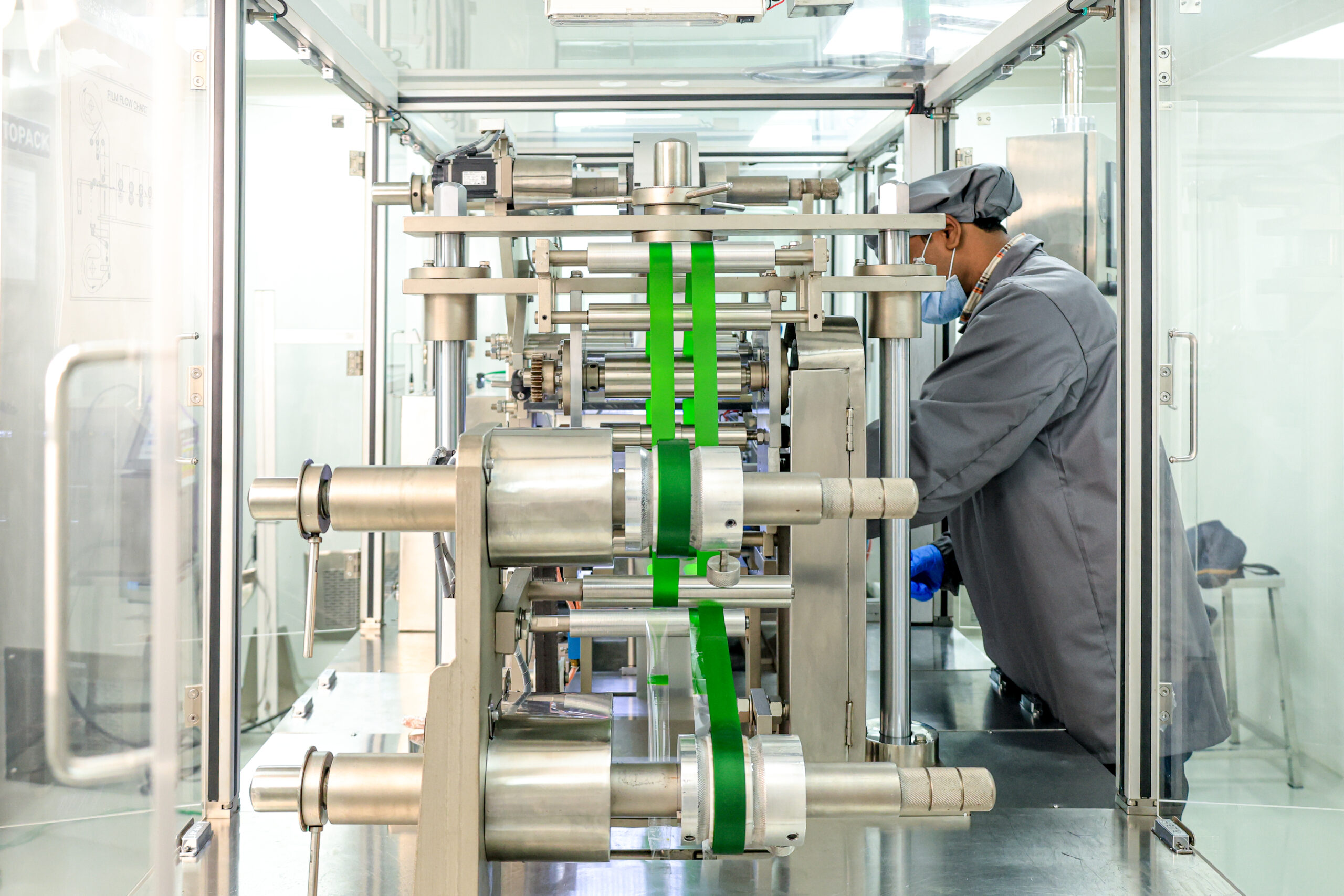
Methods of preparation include solvent casting, semi-solid casting, hot-melt extrusion, solid dispersion, and rolling methods. Solvent casting remains the dominant commercial method for pharmaceutical OTF manufacturing due to its versatility, scalability, and broad API compatibility.
The solvent casting process involves five critical stages:
Stage 1: Casting solution preparation
The API and excipients are dissolved or uniformly dispersed in an aqueous or organic solvent system. Complete, homogeneous dispersion at this stage is the prerequisite for content uniformity in the finished film. High-shear mixing, ultrasonication, and controlled temperature are used to ensure stable, uniform dispersions.
Stage 2: Deaeration
Air bubbles entrained during mixing must be systematically removed through vacuum processing or controlled rest periods before casting begins. Air voids in the casting solution become localised areas of reduced API content in the finished film — a direct content uniformity failure.
Stage 3: Knife-over-roll coating
The deaerated casting solution is applied to a moving release liner at precisely controlled wet film thickness using a knife-over-roll coating system. Coating uniformity across the full web width determines content uniformity across the batch.
Stage 4: Multi-zone drying
The cast film travels through a drying oven with independently controlled temperature and airflow zones. Precise drying profile control prevents residual solvent (regulatory failure), film blistering (structural failure), and internal stress accumulation (brittleness and delamination).
Stage 5: Precision slitting
The dried film web is slit into lanes and cut into individual unit-dose strips using die-cutting or laser slitting technology. Dimensional precision maintains dose accuracy established during casting.
Hot-Melt Extrusion — The Solvent-Free Alternative
Hot-melt extrusion (HME) processes API and polymer together at elevated temperatures without organic solvents. HME is preferred for heat-stable APIs and formulations requiring sustained release profiles. Evaluation methods ensure quality control, covering aspects like weight uniformity, thickness, dryness, surface pH, tensile strength, disintegration time, and in-vitro drug release studies.
Nanotechnology Integration
OTFs are becoming increasingly popular owing to their quick onset of action, ease of administration, and portability. They are particularly suitable for drugs that require rapid relief, have poor water solubility, or benefit from bypassing first-pass metabolism.
Nanotechnology is addressing the poor water solubility challenge directly:
Nanosuspensions: Reducing API particle size to the nanometre range increases surface area available for dissolution — dramatically improving bioavailability for BCS Class II and IV APIs
Nanocomposites: Drug-polymer nanoparticles that disperse uniformly in casting solutions, enabling high drug loading with excellent content uniformity
Niosome-embedded films: Research has demonstrated that niosome-embedded HPMC films achieve prolonged release of APIs including metoprolol tartrate — validating the combination of nanocarrier and OTF technologies
Related Article: Oral Thin Films vs Tablets
Clinical Benefits — The Patient and Brand Outcomes
This dosage form consists of an ultra-thin oral strip that quickly disintegrates and dissolves in the mouth, enabling rapid medication release for oromucosal absorption.
The compliance advantages of fast-dissolving OTFs are most significant for three patient populations:
Paediatric patients: Children who refuse tablets or cannot safely swallow capsules reliably take OTFs that dissolve in seconds with a palatable flavour. This transforms dosing reliability for paediatric medications — a clinically significant improvement.
Geriatric patients: Dysphagia affects 15% of the general elderly population and up to 68% of nursing home residents. OTFs dissolve without swallowing — eliminating the dysphagia barrier that makes conventional tablets unsafe or impractical for this growing patient population.
Psychiatric and neurological patients: IGALMI (dexmedetomidine sublingual film) approved April 2022 and KYNMOBI (apomorphine sublingual film) demonstrate the specific clinical utility of fast-dissolving OTF delivery in acute psychiatric and Parkinson’s disease management.
Enhanced Bioavailability: Sublingual OTF delivery bypasses first-pass hepatic metabolism — providing higher effective drug concentrations at lower total doses for APIs with significant hepatic metabolism. For poorly water-soluble APIs, nanosuspension-based OTF formulations can increase dissolution rate and bioavailability compared to conventional tablet formulations of the same molecule.
Rapid Onset of Action: Fast-dissolving OTFs achieve measurable plasma drug concentrations within minutes of administration — compared to 30–90 minutes for conventional tablets. For acute conditions including nausea, migraine, anxiety, and acute pain, this speed differential is clinically meaningful.
Frequently Asked Questions
What is the difference between a fast-dissolving oral thin film and an orally disintegrating tablet (ODT)?
Both dissolve without swallowing but differ significantly in technology and performance. Fast-dissolving OTFs are polymer-based flexible films that dissolve in 5–30 seconds and can achieve sublingual/buccal absorption bypassing first-pass metabolism. ODTs are compressed tablets that disintegrate in 30–60 seconds but do not provide mucosal absorption advantages. OTFs generally achieve faster dissolution, more effective taste masking, and superior patient acceptability.
How quickly do fast-dissolving oral thin films dissolve?
Flash-release OTFs typically dissolve within 5 to 30 seconds on contact with saliva. Research has demonstrated more than 95% drug release within 15 minutes across physiological pH ranges — qualifying them as “very rapidly dissolving” under WHO criteria.
Are fast-dissolving oral thin films suitable for high-dose medications?
Most pharmaceutical OTFs are best suited to APIs with dose requirements below 30–40 mg per unit. High-dose APIs — above 40 mg — present drug loading challenges in the OTF format. Pre-formulation characterisation by an experienced OTF CDMO determines whether a specific API is a viable OTF candidate.
What makes fast-dissolving oral thin films more bioavailable than tablets?
Sublingual and buccal OTF delivery bypasses first-pass hepatic metabolism — the process by which the liver metabolises a proportion of orally ingested drug before it reaches systemic circulation. For APIs with significant first-pass metabolism, this bypass can improve effective bioavailability by 20–80% compared to equivalent tablet doses.
How are fast-dissolving oral thin films manufactured?
The dominant commercial method is solvent casting — where a homogeneous casting solution containing the API and excipients is applied to a release liner at controlled thickness, dried in a multi-zone oven, and cut to unit-dose dimensions. Hot-melt extrusion provides a solvent-free alternative for heat-stable APIs.
Conclusion:
Fast-dissolving oral thin film technology sits at the intersection of advanced polymer science, precision manufacturing engineering, and patient-centred clinical design. The mechanisms that enable OTFs to dissolve in seconds, absorb through oral mucosa, and deliver drugs with superior bioavailability and compliance compared to conventional tablets are not accidental — they are the product of careful formulation science and precisely controlled manufacturing processes.
For pharmaceutical and nutraceutical brands, the strategic question is not whether fast-dissolving OTF technology is scientifically validated — it is. The question is whether your product pipeline includes candidates that would benefit from OTF reformulation, and whether you have the right manufacturing partner to develop and produce them to commercial standard.
The use of OTFs in conditions like migraine, motion sickness, and anxiety, where rapid onset of action is crucial, is further boosting their adoption. The market growing at 9.8% annually through 2033 reflects clinical adoption that is accelerating — not plateauing.